
Aviator is the multiplier crash game built by Spribe that turned a single rising curve and a departing plane into one of the most-played formats in online gambling. There's no reel, no paytable, and no bonus round — just an increasing multiplier that a small red aircraft rides upward until it flies off the screen, and a single decision every round: cash out before it does, or lose the bet. That simplicity is exactly why it spread from a handful of operators in 2019 to hundreds of licensed casinos and sportsbooks worldwide. This guide breaks down how the round actually resolves, what the published RTP and volatility figures mean in practice, where the game can legally be played in Australia, and which claims about "predictors" and "hacks" are worth ignoring.
What Is Aviator?
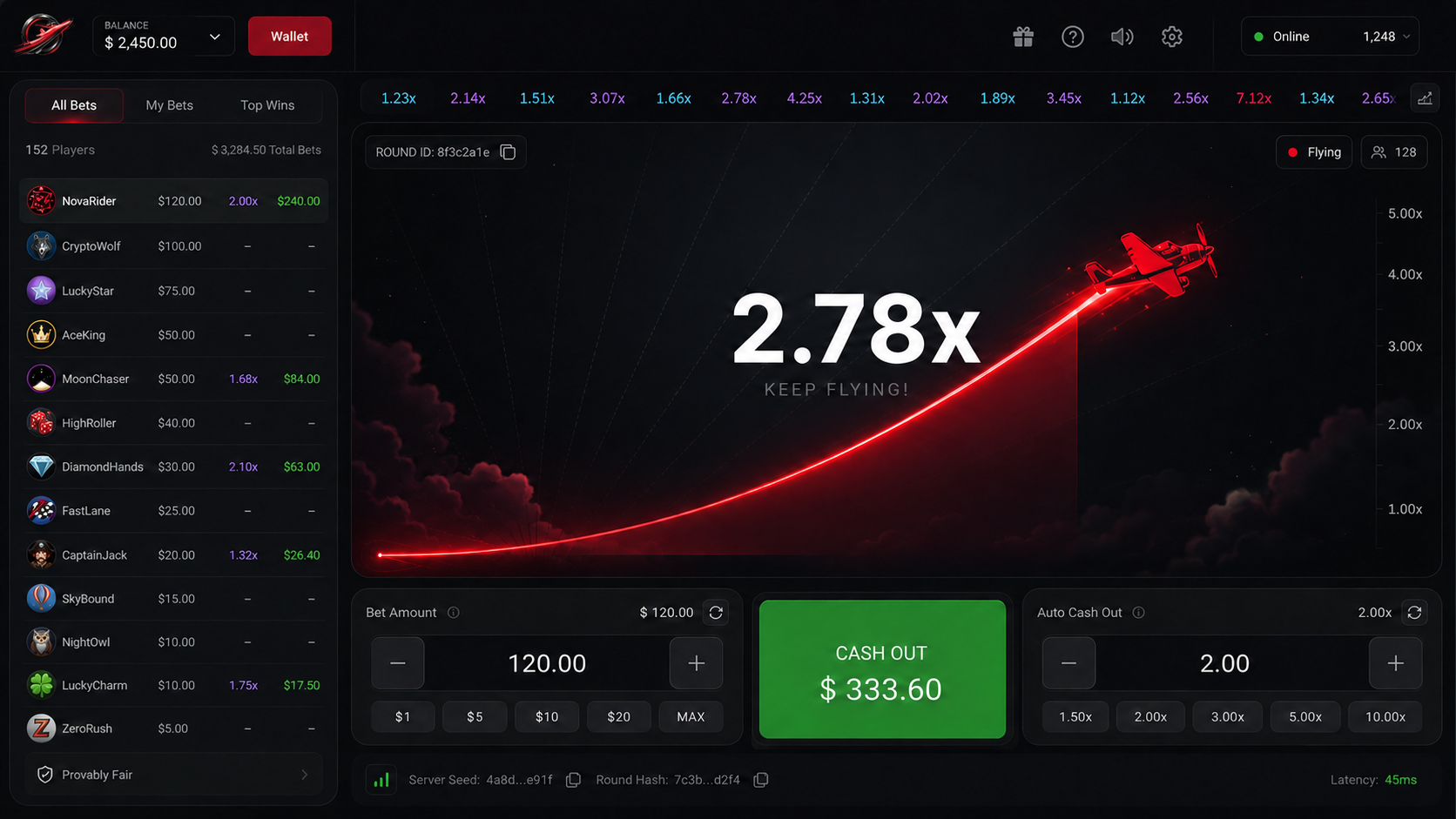
Aviator is a provably fair multiplier game, sometimes filed under "crash games" alongside titles like JetX and Spaceman, and sometimes listed in sportsbook sections because of its round-based betting structure. Each round starts with a flat multiplier of 1.00x that climbs — sometimes for a fraction of a second, sometimes for over a minute — until it hits a randomly determined crash point and the round ends instantly. Players place a bet before the round starts and choose the moment to cash out manually or via an auto-cashout setting; whatever the multiplier reads at that moment becomes the payout ratio. The interface itself is deliberately minimal: a live multiplier counter, a history strip of recent results along the top, and two independent bet panels at the bottom, each with its own stake and cash-out control.
| Detail | Information |
|---|---|
| Developer | Spribe |
| Release Year | 2019 |
| Game Type | Multiplier / crash game |
| RTP (published) | ~97% |
| Volatility | High |
| Max Multiplier | Uncapped in most builds (practical ceiling in the thousands) |
| Fairness Model | Provably fair (SHA-256 hash verification) |
| Min Bet | Typically from A$0.15 |
| Bet Panels | Two simultaneous bet slots per round |
| Demo Mode | Available at most operators, no registration needed |
| Platforms | Browser (desktop & mobile), integrated into casino apps |
How a Round of Aviator Actually Works
Every round follows the same four beats. First, a short betting window opens (usually 5–10 seconds) where players lock in a stake on one or both available bet panels. Second, the round launches and the multiplier begins climbing from 1.00x — the plane's flight path on screen is a visual representation of that number rising, nothing more. Third, at any point the player can tap cash out, which locks in whatever multiplier is showing and pays out stake × multiplier. Fourth, the round ends the instant the multiplier "crashes" — any bet still uncashed at that moment is lost in full. There's no skill involved in when the plane crashes; the only decision that matters is when to cash out relative to your own risk tolerance. A live feed of other players' bets and cash-outs runs alongside the curve at most operators, which is purely social — it has no bearing on your own round's outcome.
Provably Fair — What It Means Here
Each crash point is generated from a server seed that's hashed and published before the round starts. Once the round ends, the seed is revealed, and players can independently verify — using the published SHA-256 hash — that the crash point wasn't altered after bets were placed. This is the mechanism that makes claims about "beating" the game with prediction software mathematically meaningless: the outcome is fixed before the round begins and cannot be influenced by pattern-reading, timing, or third-party tools. We cover this in more detail, including how to run the verification yourself, on the strategy page.
RTP and Volatility, in Plain Terms
Spribe publishes a theoretical return to player of approximately 97% for Aviator, meaning that across a very large number of rounds, the game returns about 97 cents of every dollar wagered. That figure sits close to the industry average for online slots but tells only part of the story — RTP is a long-run statistic, not a promise about any single session. Volatility is the more useful concept round to round: Aviator is high-volatility, which means multipliers below 2x are common, multipliers above 10x are rare, and multipliers above 100x happen but infrequently enough that chasing them consistently drains a bankroll faster than it grows it.
| Multiplier Range | Approximate Frequency | Risk Profile |
|---|---|---|
| 1.00x – 2.00x | Most common outcome band | Low payout, high hit-rate |
| 2.00x – 5.00x | Regular occurrence | Moderate — realistic cash-out target |
| 5.00x – 10.00x | Occasional | Higher variance, fewer confirmations |
| 10.00x – 50.00x | Uncommon | High risk of the crash arriving first |
| 50.00x+ | Rare | Extreme variance, not a repeatable target |
These bands are a description of long-run distribution, not a schedule. Every round is independent, and there's no mechanism — hot streaks, "due" rounds, or otherwise — that shifts the odds based on what happened in previous rounds. Players sometimes describe patterns after the fact ("it always crashes early after a big multiplier"), but this is a well-documented cognitive bias rather than a real feature of the game engine.
Demo vs Real Money
Nearly every operator that lists Aviator also offers a free demo build that runs on the same multiplier engine with play credits instead of real balance. It's the fastest way to get a feel for how quickly multipliers move and how auto-cashout settings behave before any money is at risk. The full breakdown of what demo mode does and doesn't replicate — and how the odds compare to real-money play — is covered on our dedicated Aviator demo page, which also embeds a playable demo directly.
Strategy and Bankroll Basics
Aviator's rules are simple enough to learn in a minute, but managing a session well is a different skill from understanding the mechanics. Cash-out targets, splitting the two bet panels differently, and setting a session budget before you start all matter more than any single "system" — and we're upfront about why predictor apps and paid signals don't work, since the crash point is fixed before the round even opens. The full strategy breakdown, including common mistakes and bankroll approaches, lives on our strategy page.
Where to Play and What Bonuses Look Like
Aviator isn't hosted on a single official website — it's a game licensed by Spribe to individual casinos and sportsbooks, so registration, payment methods, and welcome bonuses all differ by operator. Bonus wagering rules matter more here than with slots, since crash games are commonly assigned a reduced wagering-contribution rate. We compare well-known operators that carry Aviator in Australia, their typical bonuses, and account setup on the where to play page.

Playing on Mobile
Aviator runs natively in the browser on both Android and iOS with no dedicated app required for the base game — it's built on HTML5, so performance is consistent across recent devices with a stable connection. Some operators also wrap the game inside their own native casino apps for a smoother interface. We've documented what to look out for, including how to avoid fake "Aviator predictor" APKs, on the mobile page.
Who Aviator Is (and Isn't) a Good Fit For
Aviator suits players who like fast, round-based decisions and want to set their own risk level rather than relying on fixed paylines or reels — a single session can involve dozens of rounds in the time a few slot spins would take. It's a poor fit for anyone looking for a low-volatility, steady-grind game, or anyone who finds rapid-fire betting hard to pace. Because rounds resolve in seconds and the next one starts immediately, it rewards players who set a plan — a session budget, a target cash-out, a stop-loss — before the first bet rather than improvising round to round.
FAQ
Is Aviator rigged?
No credible evidence supports that claim for the licensed version of the game. Aviator uses a provably fair system where the crash point is generated and hashed before the round begins, and players can verify the result afterward. Unofficial clones distributed outside licensed operators carry no such guarantee.
What is the RTP of Aviator?
Spribe lists a theoretical RTP of approximately 97% for Aviator, which is a long-run average across a very large sample of rounds rather than a guarantee for any individual session.
Can I play Aviator for free?
Yes. Most operators that offer Aviator provide a demo mode with play credits that requires no deposit and, in many cases, no account registration at all — see our demo page for a playable version.
Do Aviator predictor apps actually work?
No. Because the crash point is determined before the round starts and secured with a cryptographic hash, no external app can accurately predict it. Tools marketed as "Aviator predictors" or "signal bots" are not connected to the game's actual outcome generation.
Is there an official Aviator app?
Spribe doesn't distribute a standalone consumer app; Aviator is played through a licensed operator's website or their own casino app. Any APK claiming to be a dedicated "Aviator app" from outside an official operator should be treated as unverified.
What's the minimum bet on Aviator?
Minimum stakes are typically around A$0.15 or the local currency equivalent, though the exact figure depends on the operator hosting the game.
How do I cash out at the right time?
There's no formula that reliably beats the game's built-in edge, but setting a fixed auto-cashout target and sticking to a bankroll plan is the most common approach experienced players use — we go through this in detail on the strategy page.