
Aviator rewards discipline more than any single "system." The rules take under a minute to learn — covered in full on our how to play page — but the gap between a controlled session and a costly one almost always comes down to bet sizing and cash-out timing rather than any special trick. This page covers the strategies players commonly use, how to size a bankroll for a game that resolves in seconds, the mistakes that cost the most, and why third-party "predictor" tools don't hold up no matter how they're marketed.
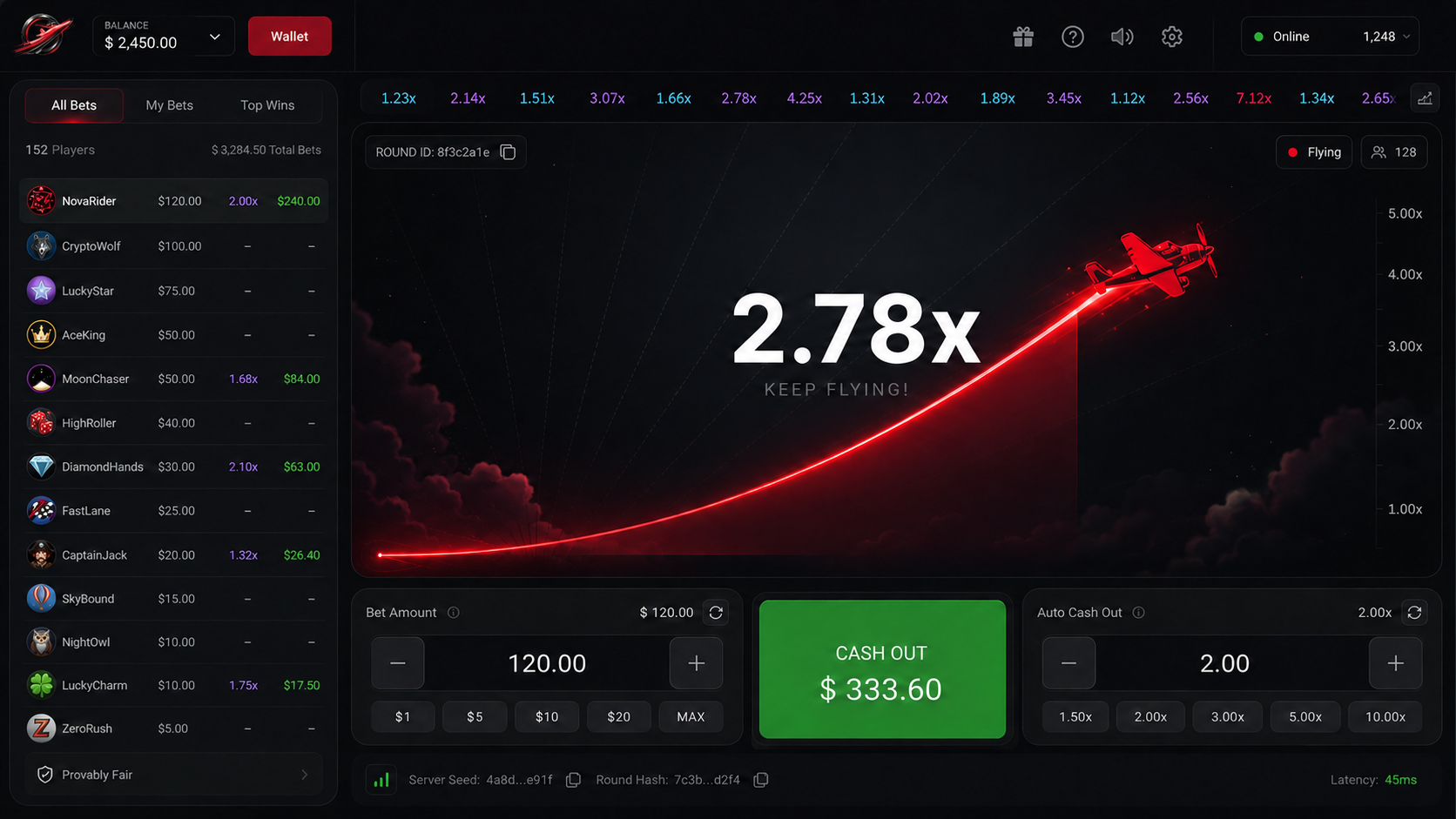
Cash-Out Approaches Players Commonly Use
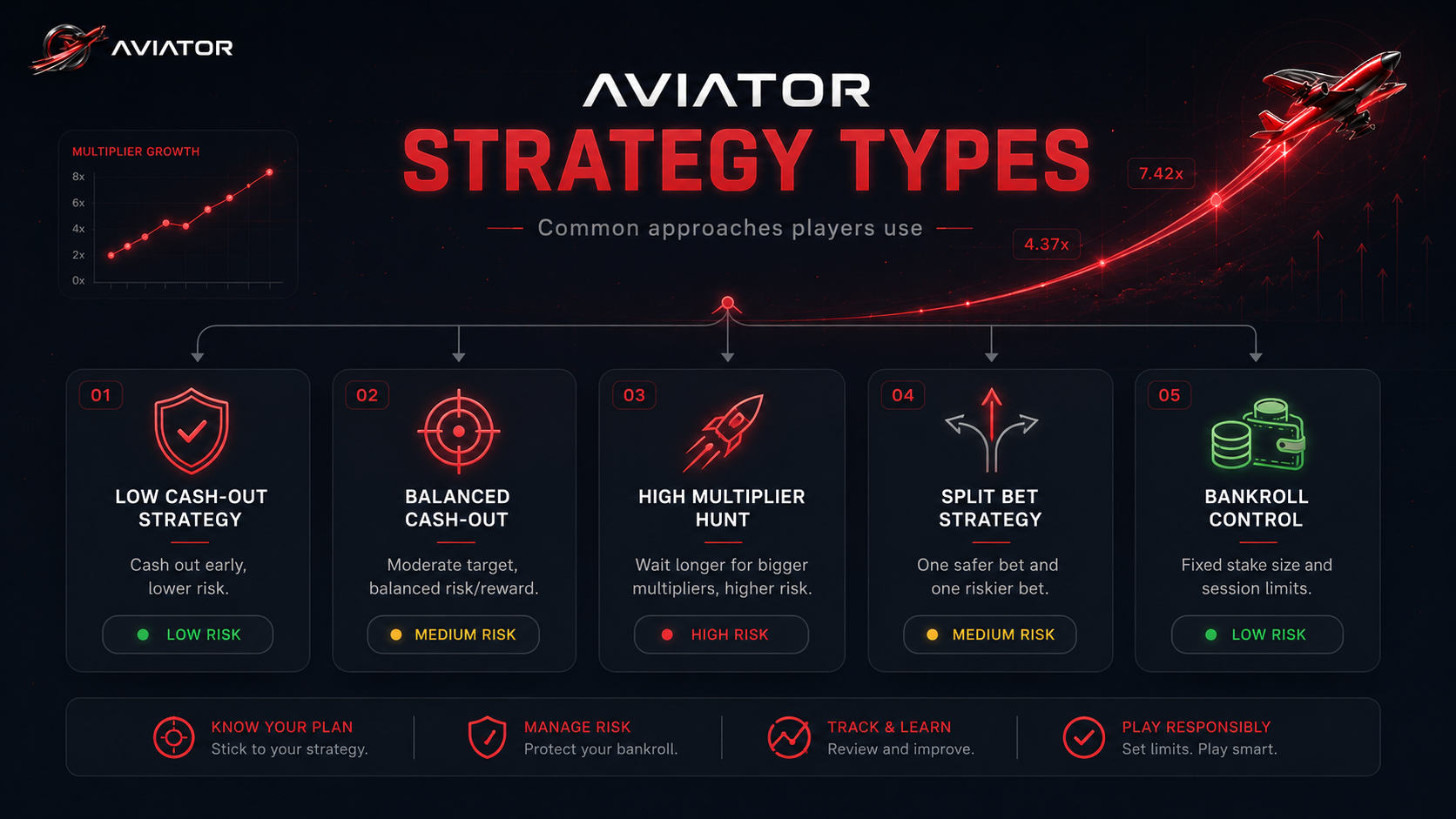
None of the approaches below change the game's underlying house edge — they're ways of shaping variance and pacing a session, not ways of beating the math. Choosing between them is really a question of how much swing you're comfortable with round to round.
| Approach | How It Works | Trade-off |
|---|---|---|
| Fixed low cash-out | Auto-cashout set around 1.2x–1.5x every round | High hit-rate, small returns, still loses in full on early crashes |
| Fixed mid cash-out | Auto-cashout set around 2x–3x | Balanced hit-rate and payout, moderate variance |
| Split panel | One panel cashes early and reliably, the other runs longer for a bigger multiplier | Smooths session results but doesn't change the long-run edge |
| Chase multipliers | Manually holding for large multipliers, resisting early cash-out | Highest variance approach; the most common source of large single-round losses |
| Flat staking | Same bet size every round regardless of previous results | Predictable, easy to budget, doesn't accelerate losses during a bad run |
| Progressive staking (martingale-style) | Increasing the bet after a loss to recover it on the next win | Can work over short stretches but risks a large loss if low multipliers cluster together |
Using the Two Bet Panels Strategically
Because most Aviator interfaces let you run two bets in the same round, a common structure is to treat the panels asymmetrically rather than mirroring the same target on both. One panel banking small, frequent wins around 1.3x–1.5x keeps a session's balance moving in small steps, while a second, smaller-stake panel left to run toward 3x–5x adds some upside without risking the whole session on one large swing. This is a way of structuring risk across a single round — it doesn't create positive expected value, since the house edge applies to both panels independently.
Sizing a Bankroll for a Fast-Paced Game
Because Aviator resolves in seconds and immediately opens the next betting window, it's easy to place far more bets in a short period than a slower game would allow — which makes bankroll discipline matter more here than in most casino games, not less. A workable structure most experienced players in Australia land on:
- Session budget — decide the total amount you're willing to risk before you start, and treat it as gone if it's lost
- Per-bet size — a small, fixed percentage of that session budget (commonly 1–5%), not a figure that scales up after losses
- Stop-loss — a point at which you stop for the session regardless of how the last few rounds went
- Stop-win — an equally firm point at which you bank profit and stop, since it's just as easy to give back gains in a fast-paced game as it is to chase losses
Do Predictor Apps, Signals, or "Hacks" Work?
No — and this is worth being direct about. Aviator's crash point for each round is generated and cryptographically hashed before the betting window even opens, using the provably fair system explained in detail on our how to play page. That means the outcome is fixed before any player, or any external tool, can act on it. No app, browser extension, Telegram bot, or paid "signal" service has legitimate access to information that could predict a crash point in advance — the game engine simply doesn't expose that data to anything outside the operator's own server before the round resolves.
Tools sold under names like "Aviator predictor," "Aviator hack," or "Aviator signals" typically fall into one of two categories: generic random-number generators dressed up with Aviator branding that have no actual connection to any real game session, or outright scams designed to harvest login credentials, card details, or subscription payments. Some request account access or ask you to install software with broad device permissions — treat any such request with the same skepticism you'd apply to an equivalent claim about predicting roulette or slot outcomes in advance, because the underlying mathematics rule it out in exactly the same way.
How to Spot a Predictor Scam
| Red Flag | Why It Matters |
|---|---|
| Requests your casino login or API access | No legitimate tool needs this to "predict" a round |
| Charges a subscription for "guaranteed" cash-out points | No tool can know a hashed, unrevealed crash point in advance |
| Distributed only as an APK outside any app store | Common distribution method for malware disguised as a gambling tool |
| Testimonials with no way to verify results | Screenshots of "wins" prove nothing about a tool's predictive ability |
Common Mistakes That Cost the Most
| Mistake | Why It Hurts |
|---|---|
| Increasing bets after a loss to "catch up" | Accelerates losses if crashes cluster below your target multiple rounds in a row |
| Holding for very high multipliers repeatedly | High multipliers are rare by design; the wait usually costs more across many rounds than it returns |
| Playing without a session budget | Rapid rounds make it very easy to lose track of total spend in a short window |
| Trusting predictor tools or paid signals | No tool can access a crash point before it's cryptographically committed |
| Ignoring bonus wagering terms on crash games | Many bonuses restrict or heavily reduce contribution from crash-game betting — see our where to play page |
| Believing in "due" rounds after a run of low multipliers | Every round is statistically independent; past results don't shift future odds |
FAQ
What's the best cash-out multiplier for Aviator?
There isn't a single "best" target — lower multipliers hit more often but pay less, higher multipliers pay more but are rarer. Most players choose a fixed target that matches how much variance they're comfortable with.
Does the martingale strategy work on Aviator?
Doubling bets after a loss can recover previous losses in the short term, but it requires a large bankroll to survive a long run of low multipliers and doesn't change the game's underlying edge.
Can I use both bet panels at once?
Yes, most Aviator interfaces let you place two independent bets in the same round, each with its own cash-out setting.
Are Aviator predictor apps illegal?
They're generally not illegal to download, but they don't work as advertised, and many carry real security risks. There's no legitimate way to predict a provably fair crash point in advance.
What is auto cash-out and should I use it?
Auto cash-out locks in a payout automatically once the multiplier hits a value you set in advance. It removes the temptation to hold too long in the moment and is widely used for that reason.
Is there a strategy that guarantees a profit?
No. Aviator is a game of chance with a built-in house edge; every betting pattern still operates within that edge over the long run.
How big should my bankroll be for an Aviator session?
There's no universal number, but sizing individual bets as a small, fixed percentage of a pre-decided session budget — rather than scaling up after losses — is the approach most experienced players settle on.